

For years, crypto security has been dominated by a pretty familiar narrative:
“If you want real security, buy a hardware wallet like Ledger or Trezor.”
And while these devices have served millions of people well, we’re entering a new era, one where the industry is beginning to ask harder questions:
Do we really need special/custom hardware devices to secure digital assets?
What happens when firmware goes out of date or the device becomes unsupported or hacked?
Why must users trust proprietary software stacks that can introduce bugs or supply-chain risks?
Enter a different kind of solution, one that merges the battle-tested reliability of enterprise authentication with the flexibility of modern blockchain design.

A YubiKey, paired with the right blockchain architecture (like XPR Network) and the right wallet (WebAuth.com), can function as a fully-fledged hardware crypto wallet-without the legacy pitfalls.
This combo doesn’t just match the security of today’s hardware wallets. It way surpasses it!
The Problem With Traditional Hardware Wallets
Hardware wallets were def groundbreaking when they launched. But like all first-generation technology, they’ve accumulated some hard limitations:
1. Firmware Dependence
Users rely on vendor updates. Stop updating, and the device could become a paperweight.
2. Software Stacks That Age Out
If Ledger/Trezor software stops being maintained, or changes direction, users may lose compatibility.
3. Proprietary Attack Surface
Closed-source firmware and specialized microcontrollers create a trust gap. Even the best teams can’t eliminate all bugs.
4. Fragile UX
Lose the cable? Wrong USB port? Need a driver? Using a new OS? Every step adds friction. The industry has tolerated this because “cold hardware” felt like the only safe option… but it’s not anymore.
How a YubiKey Can Become a Hardware Crypto Wallet
To understand this shift, you need to see the YubiKey for what it truly is: a military-grade, single-purpose signature device trusted across Fortune 500 companies, governments, and critical infrastructure.
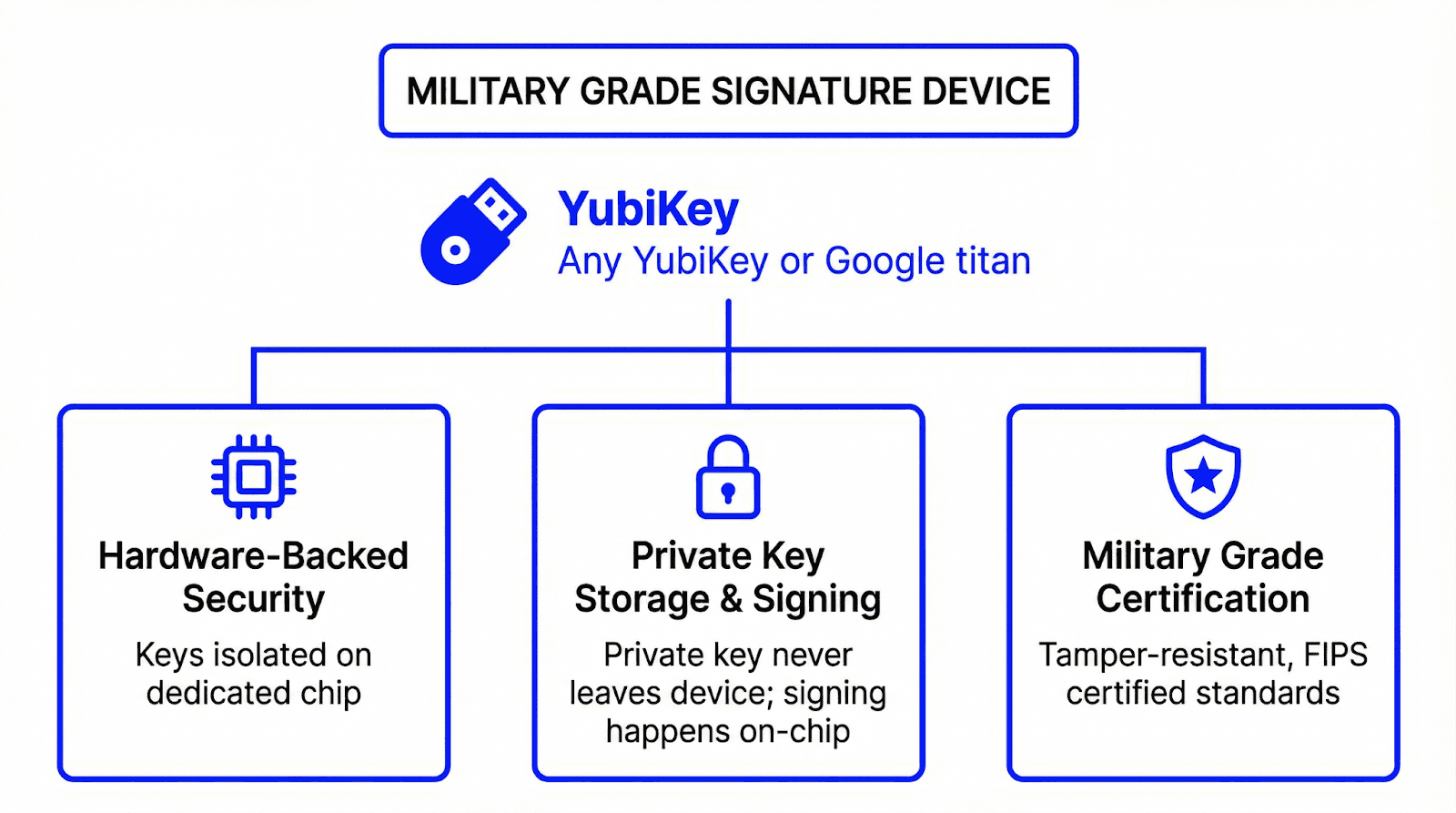
It performs one essential job: Store your cryptographic keys in a tamper-resistant chip, and sign requests without ever exposing those keys.
That’s exactly what a hardware crypto wallet does.
Now combine that with:
WebAuth.com - a browser-native, key-pair-based wallet that uses WebAuthn
XPR Network - a blockchain designed from the ground up for hardware-based authentication
And suddenly you have something insanely powerful:
A YubiKey becomes your signer.
Your browser or device becomes your interface.
Your private key never leaves secure hardware.
There’s no proprietary firmware to keep updated. No dependency on a niche hardware vendor.
No hidden software stack. Just a clean, modern, universal cryptographic device connected to a blockchain built to take advantage of it.
Why This Model Is Stronger Than Traditional Hardware Wallets
1. True Portability (MacBook, iPhone, Android, iPad, Windows, ChromeOS)
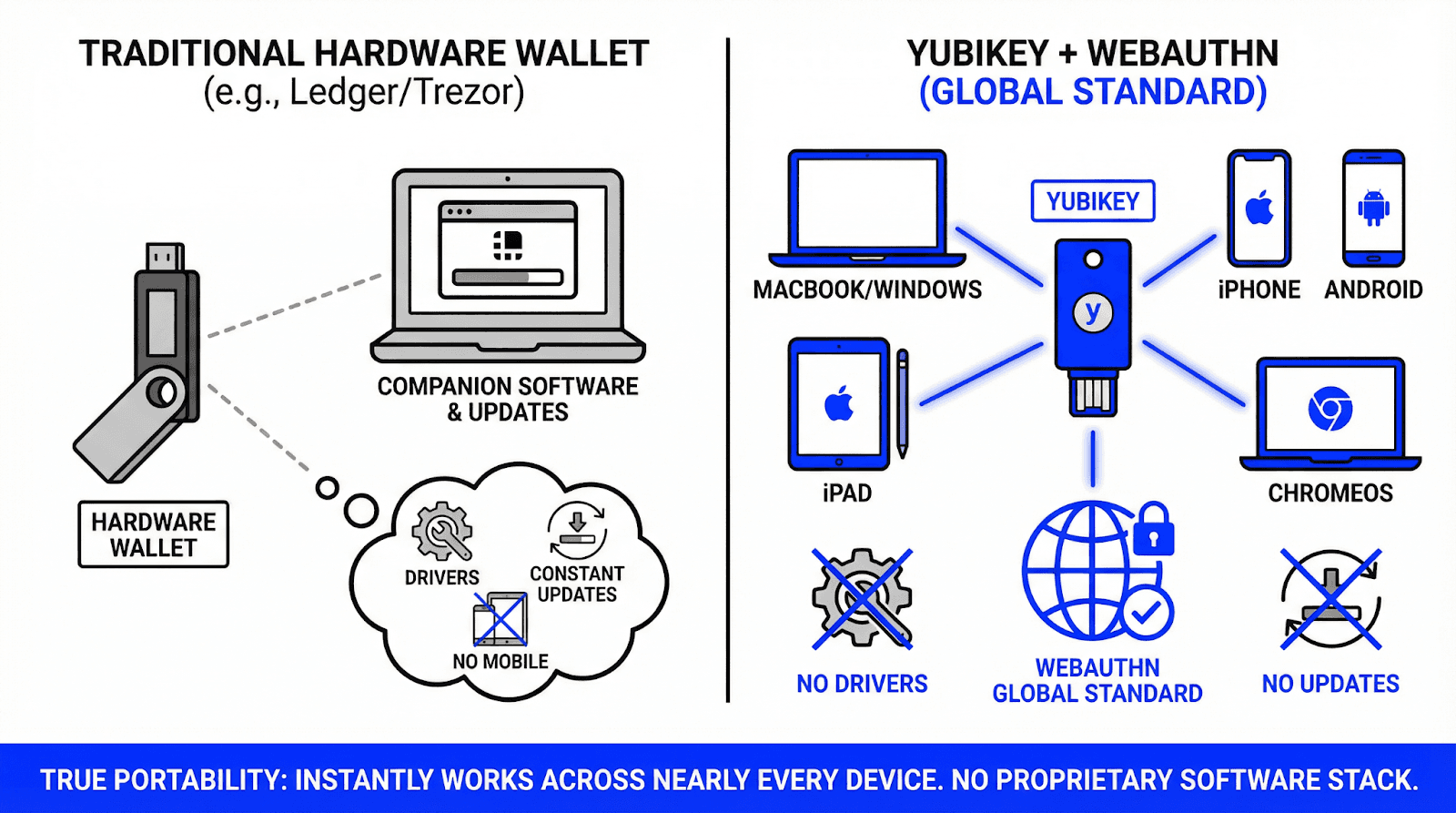
A Ledger or Trezor works only where its companion software works. YubiKey works everywhere.
Because WebAuthn is a global standard, your signer instantly works across nearly every device in existence including desktop, mobile, tablet, browser.
No drivers. No stream of updates.
2. Hardware Quality That Rivals, and Often Exceeds Hardware Wallets
Modern YubiKeys are built for authentication at the highest enterprise level:
FIPS certification
Tamper resistance
HSM-grade secure element
Multi-protocol functionality
Zero firmware update requirements
Even more importantly: They are simple.
Simplicity is the strongest form of security. It’s literally just a key, a digital signature key!
3. iOS and Android Already Include Secure Elements
This part is often overlooked: Your phone already is a hardware wallet.
Modern iPhones and Androids have secure elements that rival or surpass the chips inside a Ledger or Trezor. WebAuthn taps directly into those.
So your phone itself can act as a hardware wallet. And your YubiKey becomes the portable, air-gapped backup.
This dual-hardware model is wayyyy stronger than relying on a single proprietary device.
4. The “Air-Gapped Hardening” Layer
If you want true cold-wallet-level protection, you add one step:
Use a YubiKey that is not connected to any biometrics or cloud accounts, and store it offline.
Because WebAuthn supports multiple keys, you can:
Keep one YubiKey cold
Keep one YubiKey for daily use
Keep device-based keys (iPhone Secure Enclave, Android StrongBox) as backups
This is far more flexible than the 24-word seed phrase model and password combo, no need to expose keys on paper, no need to rely on a single recovery mechanism.
Why XPR Network Is the Perfect Pairing
Not every blockchain can support this. Most are too reliant on private key export, hot wallets, or software-based signing.
Ethereum is a perfect example of why this isn’t widely possible yet. Its core account model is still built around externally owned accounts (EOAs), which require a single raw private key for signing. WebAuthn keys can’t easily be slotted into this model because Ethereum expects signatures in a format that hardware authenticators don’t produce.
While account abstraction (ERC-4337 and beyond) is slowly moving the ecosystem toward hardware-agnostic authentication, it’s still early, complex, and not natively enforced at the protocol level.
Until Ethereum decouples accounts from raw key material and supports native multi-key or WebAuthn-style authentication, this model remains difficult and fragmented to implement.
However… XPR Network is designed differently:
🔑 Native WebAuth Support
Accounts can be created and managed directly with hardware keys, so you don’t even need seed phrases.
🔑 Multi-Key Accounts
Users can assign multiple hardware devices to a single blockchain account.
🔑 Hardware-Level Permissions
You can give one key low permissions and reserve high-value actions for your cold YubiKey.
🔑 No Seed Phrase Ever Leaves the Secure Element
Because WebAuthn generates keys inside hardware, there is never a moment where your private key for that device is visible.
This architecture mirrors how enterprise security works, because it is enterprise security.
The Paradigm Shift: From “Crypto Hardware Wallets” to “Crypto Requires Hardware Auth”
The industry is evolving past dedicated crypto-specific devices.
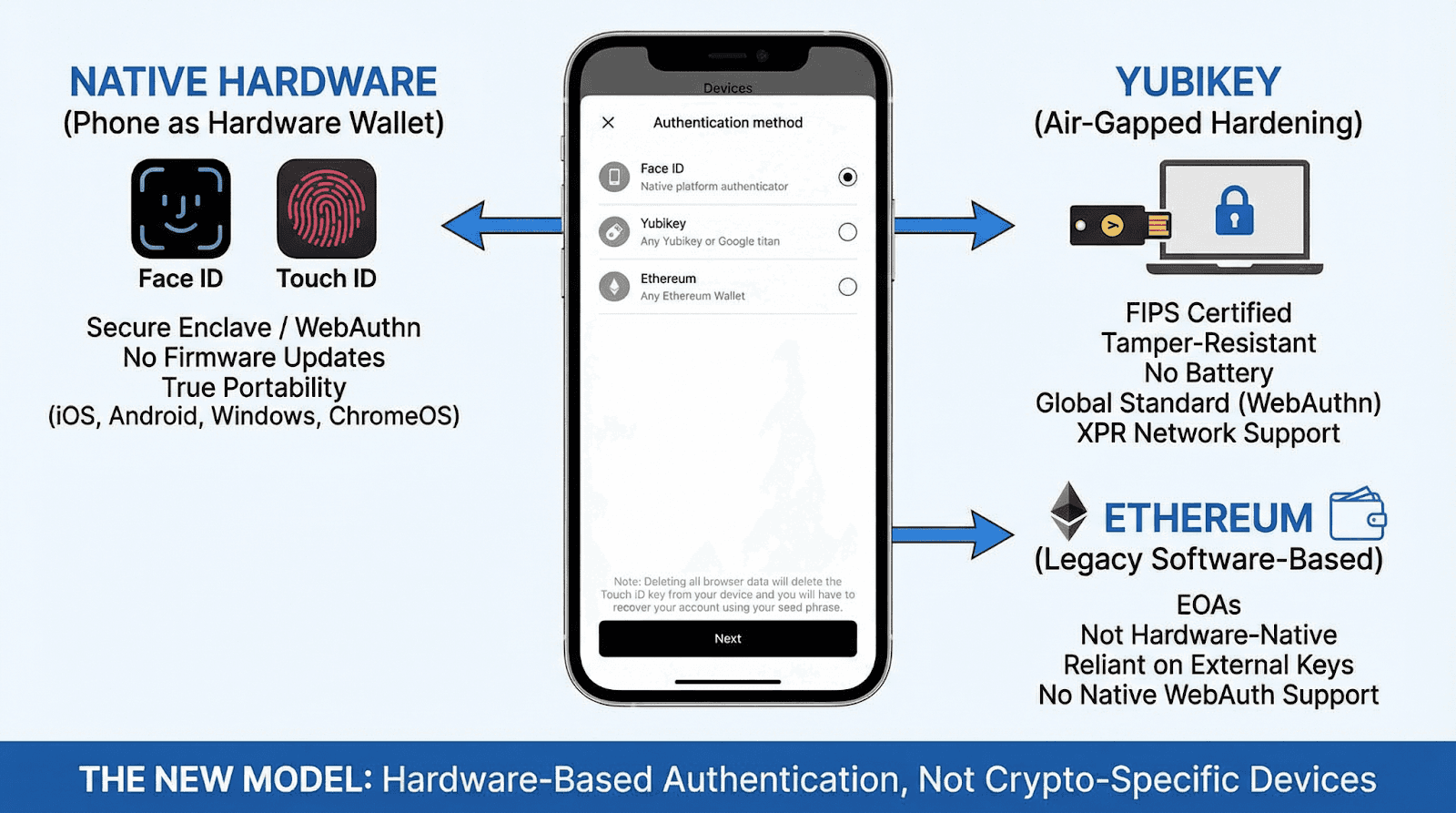
The new model is: Security comes from hardware-based authentication, not from crypto-specific hardware.
YubiKey pioneered the former.
XPR Network and WebAuth.com bring it into crypto.
Your key is your signer.
Your device is your interface.
The WebAuth Wallet is your access point.
The blockchain enforces hardware-level authentication.
And the result?
The simplest, most universal, most secure crypto experience ever built.
Conclusion: The Future of Crypto Security Looks a Lot Like the Future of Enterprise Security
Ledger and Trezor were revolutionary, and I used their products religiously. Their legacy matters.
But the next decade of crypto adoption requires something more:
Cross-platform
Standards-based
Hardware-rooted
Accessible
Simple
Durable for decades
A YubiKey, paired with WebAuth and the XPR Network, checks every box.
It’s not just a “hardware wallet alternative.”
It’s the evolution of what a hardware wallet should have always been.
The XPR Newsletter
Second To Layer None
Subscribe to our newsletter for the latest development updates, bounties, product launches + more.